The novels behind Atrus, Gehn and the fall of D'ni.
Cyan's puzzle adventures are built around linking books: books written in the D'ni Art that carry whoever reads them to the world they describe. Across Myst, its four numbered sequels and the Uru spin-off you explore those Ages mostly alone, piecing together the story of Atrus, his family and the fallen D'ni civilization from journals, letters and machinery.
The books are three novels from the 1990s, written by David Wingrove from the Miller brothers' story outlines. They fill in what the games only hint at: Atrus's youth under his father Gehn, how his grandparents met in the D'ni city, and his return to D'ni in the years between Riven and Exile. They share the games' continuity.
Start with Myst, then read The Book of Atrus before Riven. If you only read one of the novels, make it that one.
Best experience
Myst works best when you know nothing, so it comes first, with The Book of Atrus straight after: Riven's opening gives away how the novel ends, and the novel gives you Gehn and Catherine's history before you meet them. Ti'ana and D'ni follow Riven in the order they were published, and D'ni leads into Exile. After that the games split into two stories. Revelation finishes Atrus's family story, so it comes before Uru even though it came out later, and Uru, Path of the Shell and End of Ages then run straight through to the finale.
You read the last page of a strange book and find yourself on a dock, alone on a small island. In its library wait two more books, one red and one blue, each holding a trapped man. Sirrus and Achenar are brothers, and each blames the other for the burned library and their father Atrus's disappearance. Bring back the pages missing from their books, scattered across the island's linked Ages, and they'll tell you more.
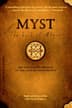
Atrus grows up in a desert cleft with his grandmother Anna until his father Gehn turns up and takes him down into the ruined cavern city of D'ni. Gehn teaches him the Art of writing books that link to other worlds, and he has large plans for what the two of them will do with it.
What this adds
If you read one Myst novel, read this. You meet Gehn years before Riven, see how Atrus learned the Art and why he came to distrust his father, and find out where Atrus and Catherine meet. The desert cleft Atrus grows up in is the same one Uru starts in. The last pages run straight into Myst's opening narration, so it works as a bridge between the first two games. It's short and moves quickly, and it makes Riven's world feel lived in before you set foot in it.
Atrus sends you to Riven, the Age where his father Gehn rules the islanders like a god, to bring back his wife Catherine. You go in with a journal and a trap book meant for Gehn, and the Age is slowly coming apart. Five islands, strange machines, villagers who hide from you and a rebel group called the Moiety all have to make sense before you can do anything about it.
Long before Atrus, the D'ni empire is at its height in its caverns under the earth. Aitrus, son of a powerful Guild family, meets Anna, a young woman from the desert above who has found her way down into D'ni. She's the first outsider anyone there has seen in a very long time, and not everyone in the city's Guilds and Council is pleased about it.
What this adds
Read this one for D'ni itself. Uru and End of Ages put you in the ruins of the cavern city, and here you see it running: the Guilds, the Council, the rules about writing Ages, and the politics that eventually wreck it all. Anna, the grandmother from The Book of Atrus, gets her own story, and you learn where Gehn comes from. It's bigger and slower than Atrus, more political history than adventure, and the D'ni names take a while to keep straight. Worth it before Uru.
After Riven, Atrus and Catherine go back down into the dead city of D'ni with a small group of helpers. Atrus breaks open the room at K'veer where Gehn once kept him and begins searching the caverns for linking books, hoping to find D'ni who survived the fall somewhere out in the Ages and bring his grandfather's people home.
What this adds
This fills the gap between Riven and Exile. Exile opens with Releeshahn already written for the D'ni survivors and never says much about how Atrus found them; this is that story. You also spend time at K'veer, the island where End of Ages begins. It's the slowest of the three novels and the least tied to anything you do in the games, but it's the only place Atrus's work on D'ni between those games is told.
Ten years after Riven, Atrus and Catherine invite you to Tomahna, their home, to see Releeshahn, the Age Atrus has written for the surviving D'ni. Before you get the chance, a stranger sets the study on fire and takes the book. You follow him to J'nanin, an Age Atrus once wrote to teach his sons, and on through the lesson Ages linked from it.
Another ten years on, Atrus calls you back to Tomahna. Sirrus and Achenar have spent two decades shut away in their prison Ages, and Atrus wants help judging whether either son has changed before he decides what to do with them. You also meet Yeesha, his and Catherine's young daughter. The visit doesn't stay quiet for long.
The present day, in the New Mexico desert. A trail leads you to a cleft in the ground, and below it the D'ni Restoration Council has been quietly reopening the ancient cavern city. But someone named Yeesha has left messages there, and they point you down a different path. This time you play as your own avatar, in third person and real-time 3D.
The second stretch of Yeesha's path, picking up after Uru. The expansion opens two new Ages, Er'cana and Ahnonay, along with more of the D'ni city, and it goes further into what Yeesha is asking of you and who the Bahro are. Its puzzles are a step up from Uru's.
A letter from an elderly Atrus, worried about his missing daughter Yeesha, brings you to his old study on K'veer, an island by the ruins of D'ni. There you find a tablet that can command the Bahro, the creatures the D'ni once enslaved. Yeesha wants you to learn how to use it. Esher, a survivor of D'ni's fall, warns you not to trust her.